Late last year I decided to get serious about AI at Tunga. Not the "give everyone a ChatGPT license" kind of serious. Structurally serious. Redesign how we work.
The first question was obvious: where on earth do I start?
Turns out I'm not the only one. Every entrepreneur I've spoken to in the past few months has the same question. And every major survey published in the past twelve months confirms it:
- McKinsey: 88% of organizations use AI. 7% have implemented it structurally.
- BCG, different methodology, same conclusion: 72% of employees use AI regularly. 60% of companies generate zero measurable value from it.
- Cisco classifies just 13% of organizations as fully AI-ready.
Everyone has started. Almost nobody has arrived. Here is what I have encountered on the way.
Tools first, questions later
Most companies do the same thing first. Ours included. Make tools available. Switch on Copilot. Get a team license. See what happens.
Something happens. Some people take to it immediately. Others open it once and never touch it again. A few get measurably better at their work. Others start producing output that looks polished but is somehow emptier than before.
MIT studied this pattern inside organizations. Power users send six times as many messages to AI tools as the median employee. For coding, the difference is sixteen times. Same company, same tools, radically different outcomes. EY adds that 78% of employees use unapproved AI tools, while only 7.5% have received extensive training.
The picture is familiar: uneven adoption, uncoordinated use, nobody overseeing whether it adds up. But here is the thing. The problem is not the tools. The problem is that nobody asked a certain important question before deploying them.
The question almost everyone skips
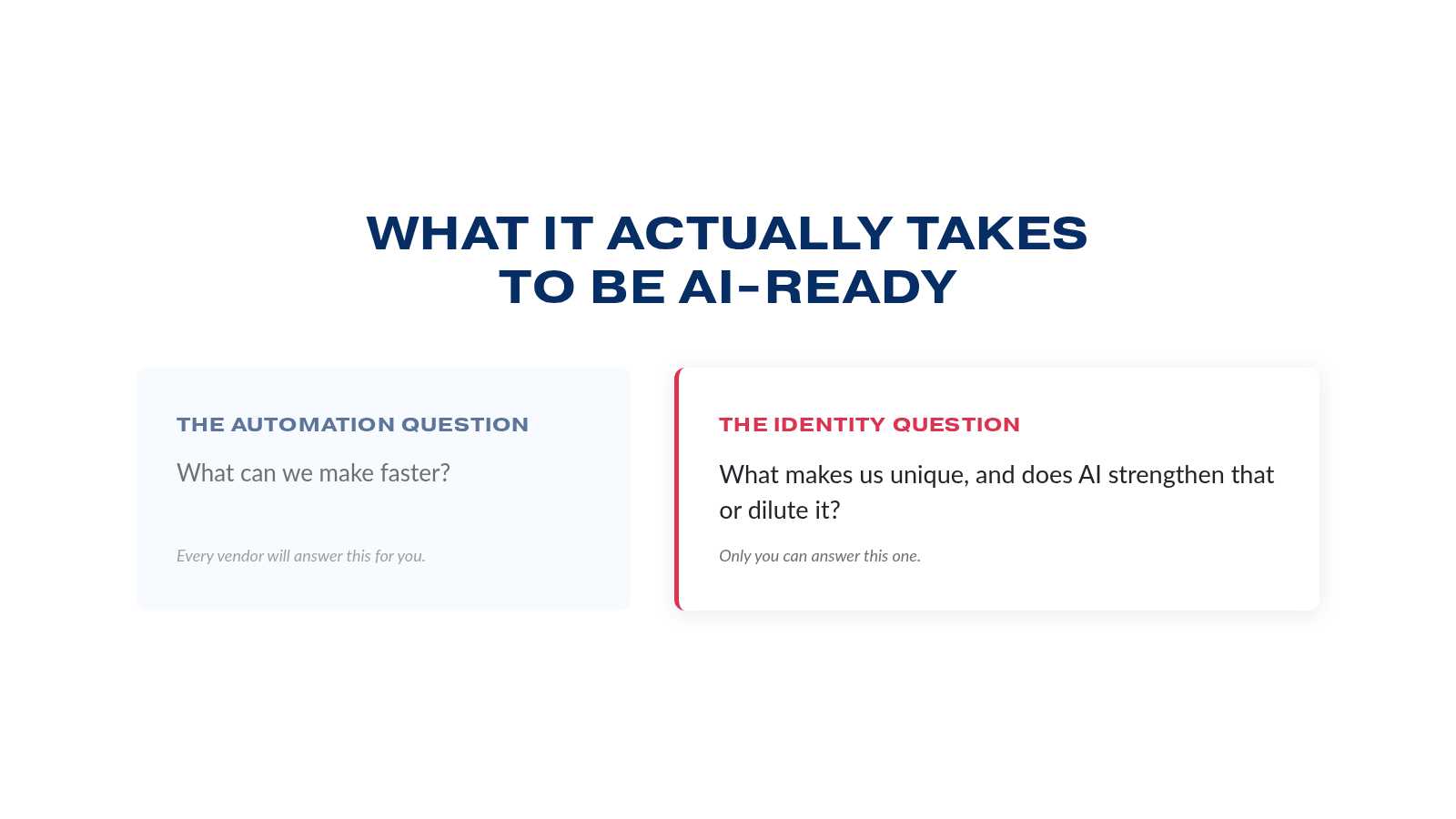
That question is: what are we uniquely good at, and how do we make sure AI strengthens that rather than undermines it?
I can make this concrete. At Tunga, one of the things that sets us apart is personal contact. Our clients work with developers in Africa. That requires building trust in ways you cannot automate. If I were to optimize that away because it is more efficient, I would be competing with Toptal and Upwork in a game I cannot win.
Every company has a version of this. Something that makes them distinctive, that is tempting to automate, and that would hollow them out if they did.
The most visible example of getting this wrong is content. My LinkedIn feed is full of it. Professional-looking but soulless. Generic, interchangeable, belonging to nobody. The internet calls it "AI slop." Merriam-Webster chose it as word of the year. Consumer trust drops 50% when content is perceived as AI-generated.
That is what happens when you automate without direction. You produce more, but you get worse. And it is not limited to content. Any part of your business where the human element is what creates value is vulnerable to the same pattern.
Mapping our workflows
Once I understood this, I tried to do it properly. I started a project to map all of our workflows and redesign them with AI in mind. Everyone on the team contributed.
The quality varied significantly. Not because people were not trying, but because thinking about where AI fits into a workflow is a skill. One person immediately saw where a process could be more efficient. Another described the current situation and stayed there.
Halfway through I realized: this needs structure. It felt like being a football coach who lets everyone onto the pitch and hopes they figure out their positions. Not everyone needs to be good at the same thing. But someone has to set up the team. At Tunga, that meant deliberately creating two roles: a Context Architect to design how AI integrates into our workflows, and a Context Manager to keep it running day to day.
This turns out to be a broader pattern. One in four companies now has a Chief AI Officer. "AI Engineer" is the fastest-growing job title on LinkedIn. A new role, the "Context Engineer," is appearing: someone who structures the information that makes AI systems perform well. Organizations are discovering that AI readiness requires dedicated attention, not just distributed enthusiasm.
But even having the right people is not enough if you are not clear on what direction to point them.
Strategy as the actual dividing line
Cisco found something striking. Of the companies they classify as fully AI-ready, 99% have a well-defined AI strategy. Across all companies: 58%. Companies without a formal strategy report 37% success in AI adoption. Those with one: 80%.
Yet only 21% have actually redesigned workflows around AI. The rest layer AI onto existing processes and hope for the best.
The dividing line is not technology, budget, or company size. It is whether someone has forced the question: what are we protecting, what are we strengthening, and what are we willing to let change?
Where this leaves the question
I started with "where do I start?" The answer I have found so far is not a tool or a vendor. It is a sequence. Free up one or two people to focus on this, not on the side of their regular work. Map your workflows before deploying AI anywhere. And answer the identity question: what makes you distinctive, what must be protected, where does AI strengthen your advantage and where does it erode it?
Follow this path, and something shifts. You stop reacting to every new tool and start making choices that compound. That is when AI stops being a distraction and starts being an advantage.